
How it's made
From Fedrigoni mill to your hands
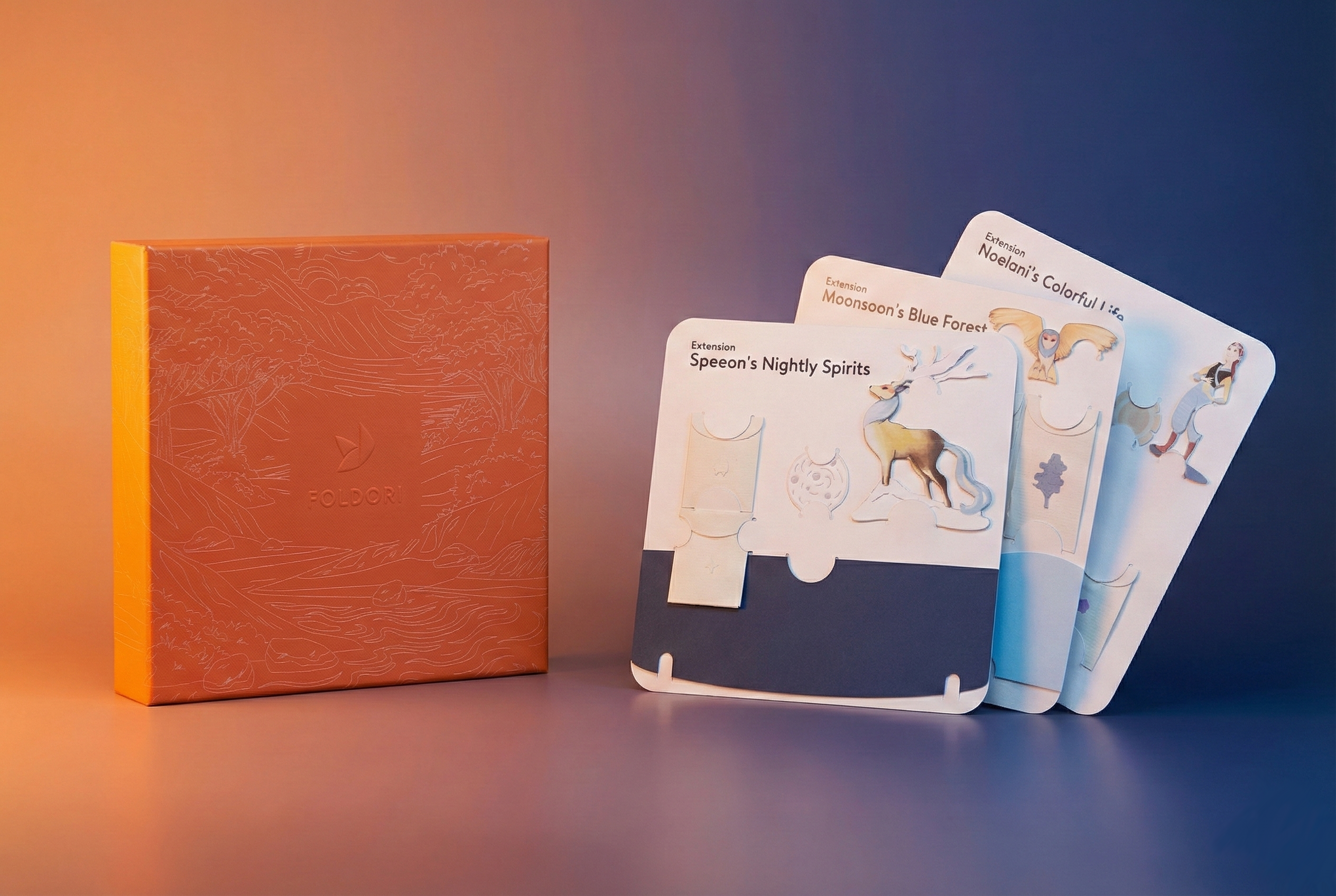
Every FOLDORI set begins with uncoated cream paper sourced from Fedrigoni, one of Italy's heritage paper mills. We chose this stock because its long fibers hold a precise fold and because the uncoated surface reveals the paper's natural texture. The grammage matters: 250 grams per square meter is heavy enough to support a multi-layer structure without glue, light enough to cut cleanly under a CO2 laser.
Our manufacturing partner in Europe receives the paper in sheets. Each layer is laser-cut to tolerances tighter than the supplier's standard, a discipline we learned after four months of prototyping. The CO2 laser seals the cut edge as it moves, which is why FOLDORI layers do not fray.
The assembly you finish
We engineer the score lines at specific angles so the paper locks under tension. A 38-degree fold, for example, holds its position the first time you crease it. The Paper Belt mechanism is the structural reason no glue is required: the belt runs through pre-cut slots and pulls the layers into alignment as you tighten it.
Each set ships with a Design Handbook printed on Fedrigoni Old Mill 120gsm. The handbook walks you through the assembly in photographs and step-by-step instructions. You place, you fold, you tighten. The object you display is the object you built. Questions that come up mid-build are answered in our FAQ.
Why European production
Made in EU is not a marketing claim for us; it is the manufacturing constraint we set at the start. We wanted short lead times, direct communication with the production line, and the ability to visit the facility when a tolerance issue surfaced. European paper mills carry a tradition we respect, and working inside that tradition means we can name the mill, name the stock, and stand behind both.
The Sunrise Dreams Classic Set you assemble is the result of these choices: Italian paper, European manufacturing, tolerances we argued for, a story we wrote, and a mechanism we engineered. You own it because you finished it.
The craft tradition behind every cut
The cutting and folding techniques behind every FOLDORI layer draw on a much older lineage. Read more on kirigami, the Japanese art of cutting paper into three-dimensional form; on cutting paper art as a broader craft tradition; or on paper art as a medium, if you want to go deeper into the technique behind the object you assemble.