
The search for the "Perfect Fit"
When I walked in, Maïa was surrounded by what looked like a paper blizzard. "It isn't as glamorous as it looks, Nicola", she said, holding up a discarded owl wing. "We design every bits and pieces to find the perfect combination of material and mechanism".
1. Material sourcing
Some companies simply pick a paper from a catalog, the right colour for their project, and then hope for the best. FOLDORI treats the sourcing of 250gsm paper as a rigorous audition.
We start with the technical data: we go down to the last detail of the spec sheet listing pH values, tensile strength, and water absorption, but that’s only the beginning.
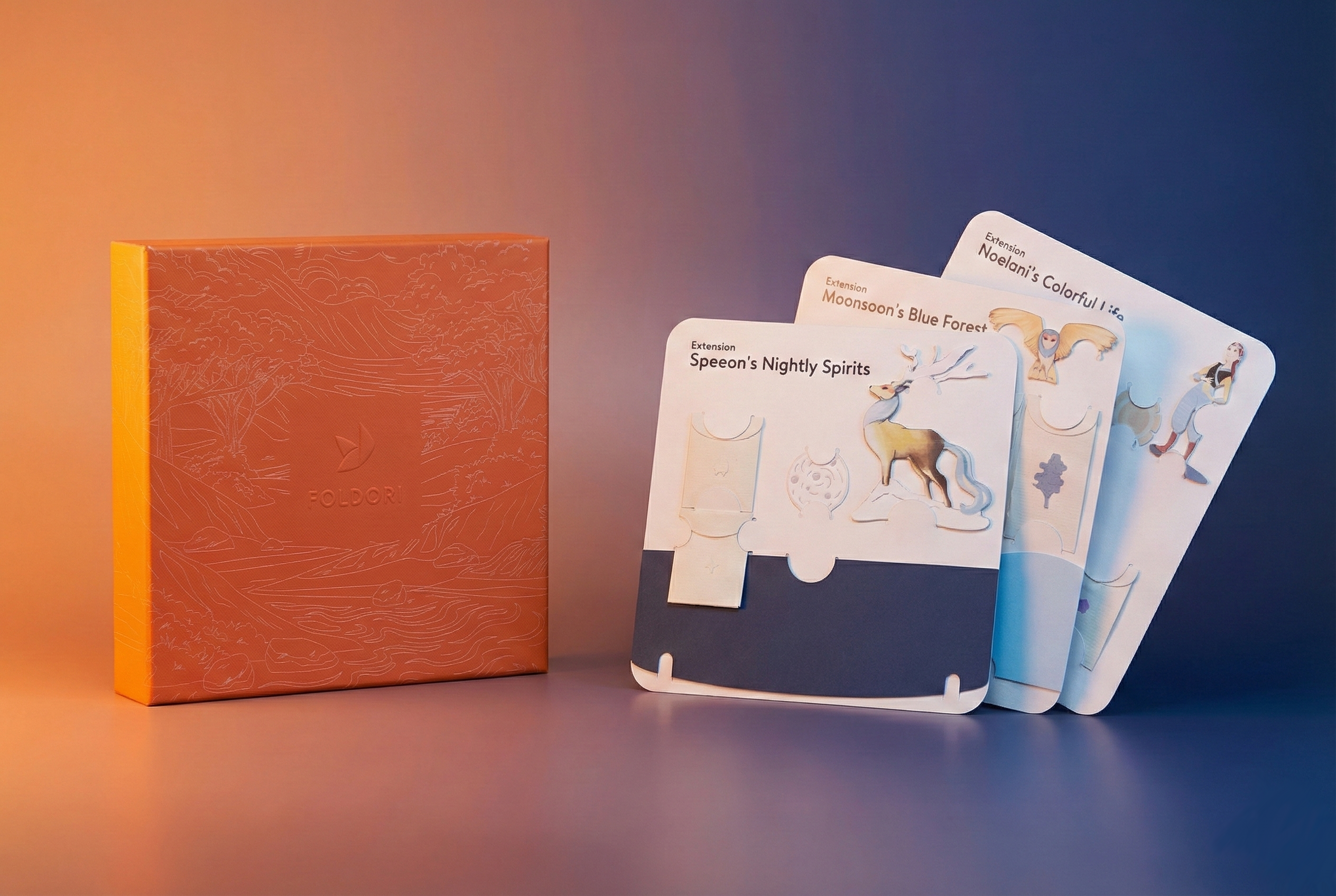
We then order dozens of samples from our European suppliers to test how they would handle CO2 laser cutting, offset printing and multiple finishings applied to our sets. We prototype and narrow down options until a technical solution and its paired paper match our designs. For elements like Speeon’s spirits, Maïa might reject twenty different types of white paper because they don't have that specific "soft, ghostly" tactile feel she demands.
2. Drawings, early prototypes, and failures
Until a set is perfect, the team enters in an iterating loop frenzy. I saw a stack of hundreds of drawings on Miraki’s desk. He explained that for every character like Noelani, there are fifty other versions that never made it out of the lab. Because our assembly is glue-free, and our dimensions often small and intricate, interlocking and weaving mechanisms must align perfectly. A slit 0.2mm too wide means the paper wobbles; a belt 0.2mm too narrow, and the paper tears.
Talking about colour theory: Maïa reminded me that they went through nine different colour palettes for the Sunrise Dreams: Classic Set alone. They have to test how the Noelani orange looks when stacked behind four layers of Moonsoon blue, ensuring the character's creative traits still radiates through the set's depth.
3. From a prototype to a mindful assembly
The most honest part of Maïa's role in Miraki's Prototyping Lab is the Zero-Talent test.
With Miraki's support, the team builds and rebuilds these early prototypes until the assembly time hits that 40-minute flow state zone. We integrate features like the Paper Belts as early in the process as possible, but never until we're 100% sure the intended design is technically translatable into a three-dimensional, papercut art piece. It took months of "breaking things" from the first drawing to the final step of implementation to ensure that the belt was both innovative and satisfyingly easy to use.
Finally, Maïa’s Design Handbook is drafted here, alongside Miraki and all his prototypes, to ensure the step-by-step guide matches the tactile reality of paper.

What moved me most in this lab was the sheer volume of 'failure' required to reach excellence. We see the finished Sunrise Dreams set and think it was a single stroke of genius. In reality, it's the result of hundreds of discarded drawings and samples that weren't 'quite right'. It is a humble reminder that being world's first is earned, not accidental.
When you feel how perfectly a character like Noelani fits into the Silvia Forest as a story, a paper element, and in a colorful ensemble, remember the 'paper blizzard' I saw in the Lab. That fit is the result of Miraki and Maïa refining the dimensions until they were exactly right. Trust the story, shapes, and colours you’re holding: they’ve faced countless obstacles to end up in your creative hands!