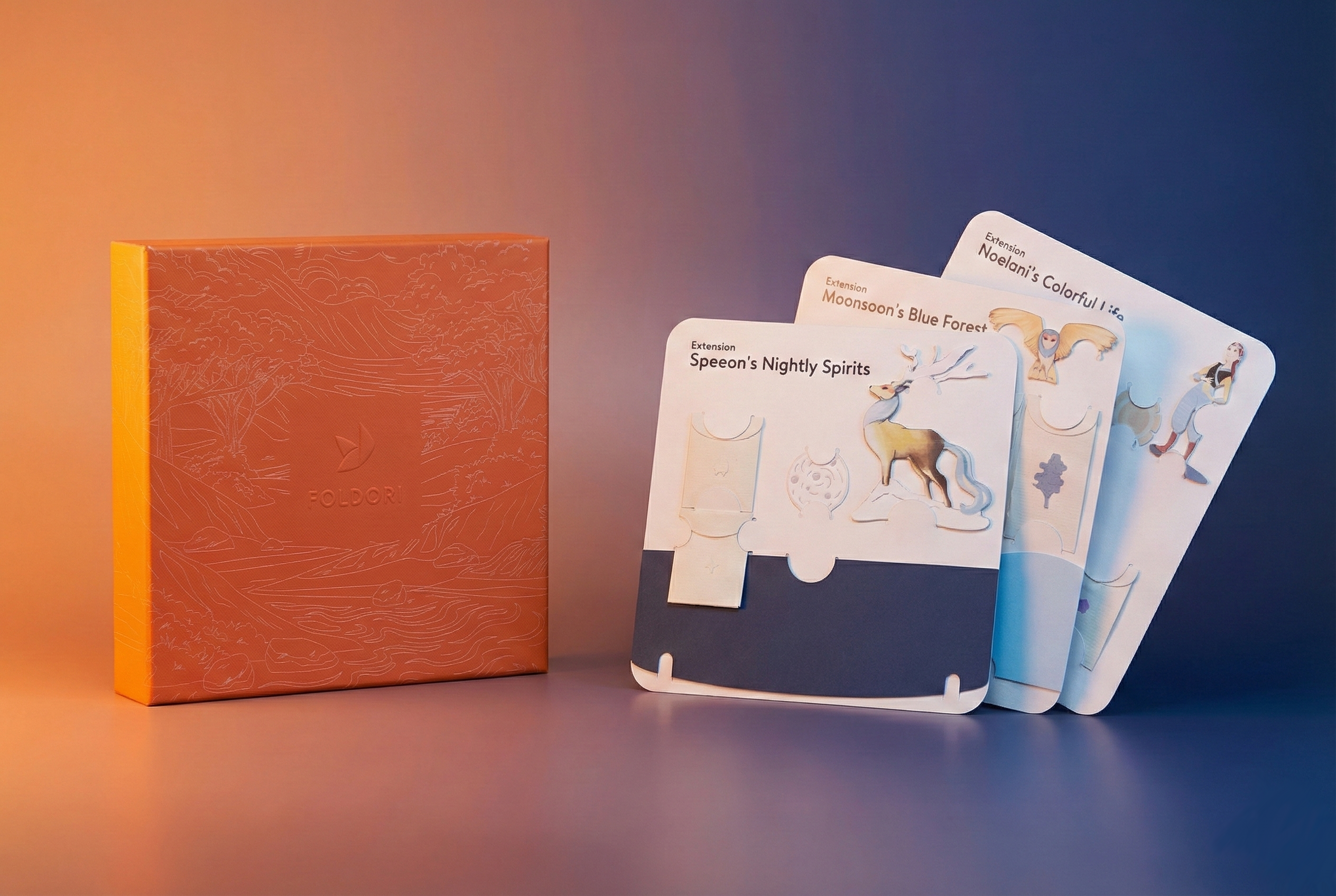

Sunrise Dreams
The world's first Paper DIY diorama based on a short story.

What's a diorama?
A diorama is a three-dimensional mini-world. Whether it's a historical moment, a scene from a book, or a blue-and-orange landscape, a diorama uses depth and scale to tell a story in a way a flat image cannot. The term was coined in 1822 by Louis Daguerre, the 'father' of photography, and originally referred to a theatrical set with moving lights and paintings. This is why dioramas create an immersion of depth.
At FOLDORI, craft meets narrative. Beyond the landscape, our story-based diorama focuses on 'The Encounter' between its three characters. It’s a form of visual storytelling where the creative power of paper does all the talking.
Paper DIY fundamentals
1. The Material Science (GSM and Grain)
In paper DIY, the "weight" of the paper (measured in GSM: grams per square meter) dictates what you can build:
- 80–120 GSM (Standard Paper): too thin for structures, but perfect for "ephemera" inside a diorama (tiny letters, newspapers, or wallpaper).
- 160–220 GSM (Cardstock): usually deemed as the "sweet spot". It’s sturdy enough to stand on its own but flexible enough to fold without cracking the fibers.
- 250 GSM (FOLDORI Paper): because our users are not all DIY aficionados, our premium materials give them the confidence necessary to a successful self-assembly.
- 300+ GSM (Heavy Cover): used for the "structural walls" or the base of the diorama. In Sunrise Dreams, we use 400 GSM paper.
- The Grain: like wood, paper has a grain. If you fold with the grain, the fold is smooth; if you fold against it, the paper "cracks" and looks messy.
2. Structural Techniques
- Scoring: by lightly running a blade or bone folder along a line (without cutting through), you break the surface tension of the paper, allowing for a perfect 90-degree angle.
- Tabs and Flaps: instead of just gluing edges together, you leave small "tabs" on your pieces that fold inward. This provides a larger surface area for the glue, making the structure much stronger.
- Layering (Depth): in a diorama, you create the illusion of miles of space in just a few inches by using forced perspective. Objects in the "background" are smaller and less detailed, while "foreground" objects are larger and high-contrast.
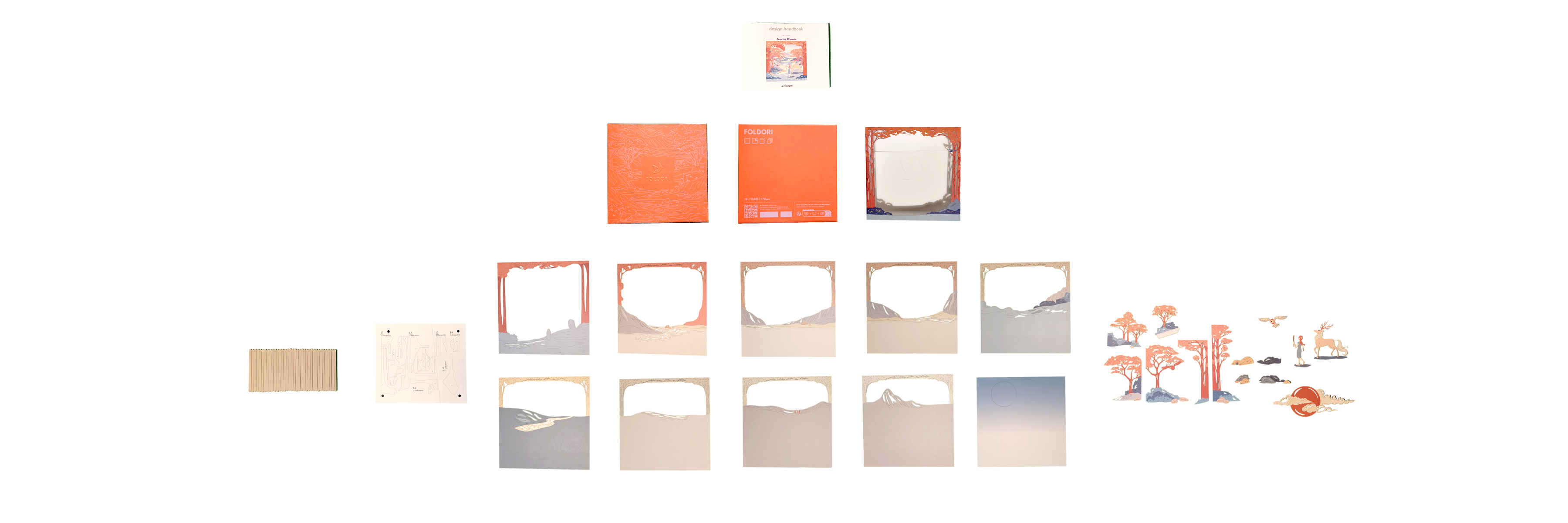
Our diorama is pre-scored, our 90-degree angles handled by Paper Belts, and we spent months mixing the layering technique and color theory into what we call Depth Engineering.
3. The Toolkit
In traditional paper DIY, scissors are rarely enough. You typically need to own:
- A precision knife: essential for "fussy cutting" (cutting out tiny, intricate shapes).
- A self-healing mat: to protect your table and keep your blade from dulling instantly.
- A bone folder: a dull, bone-like tool used to create a score line. You need to "score" a light groove first so the fold is razor-sharp.
- Tweezers: for placing tiny elements into a diorama.
Obviously, to us, the toolkit was a red flag from the start. So we spent 2 years in R&D to create a whole new type of Paper DIY: tool-free, glue-free, and 100% recyclable.
FAQ
Check out Nicola's ressources and find a quick fix to your question.
Is it suitable for children?
Is it suitable for children?
No, the Sunrise Dreams collection is made of very small elements. Designed for ages 16+.
Does Sunrise Dreams come fully packaged?
Does Sunrise Dreams come fully packaged?
Yes, Sunrise Dreams comes in a premium case designed for storage and display. When shipped it's also covered by a kraft box to protect it against weather and transport conditions. All materials used from shipping to the fully assembled set are 100% recyclable.
What precautions should I take?
What precautions should I take?
The Sunrise Dreams collection is made of highly-delicate paper pieces. We've engineered it so you don't have to use tools or glue.
How long does shipping take?
How long does shipping take?
Standard delivery takes 2 to 4 business days in France and 2 to 8 business days in the rest of the European Union. Express delivery is available at checkout. Outside the European Union, delivery times depend on the destination. You will receive a tracking number once your order has shipped so you can monitor its progress.
Do you ship internationally?
Do you ship internationally?
Yes, we ship internationally! We do however take great care of our carbon footprint so our supply chain is geared towards Europe shipping, with international shipping made through consolidating multiple orders in the same region. Please note that shipping times and costs may be quite extensive depending on the destination country. Contact us and we'll make sure to support the best we can!
What payment methods do you accept?
What payment methods do you accept?
We accept a variety of payment methods to make your shopping experience convenient. These include credit cards (Visa, Mastercard, American Express), PayPal, and, in some regions, alternative payment methods such as Apple Pay or Google Pay. Your payment information is secure and protected during the checkout process.