
Extended digital fatigue
We’ve all been there: finishing a ten-hour workday in front of a monitor only to "relax" by staring at a smaller screen in our hand. It’s a closed loop that leaves the brain in a state of low-level alert.
To truly decompress, the brain needs screen-free tactile feedback. It needs to feel textures, judge distances, and manipulate physical objects. Research into embodied cognition suggests our motor skills and our emotional regulation are deeply linked. When we use our hands for precise tasks, we effectively "ground" our nervous system.
Here are five hobbies that actually help you recalibrate, picked by Nicola.
1. High-precision paper engineering
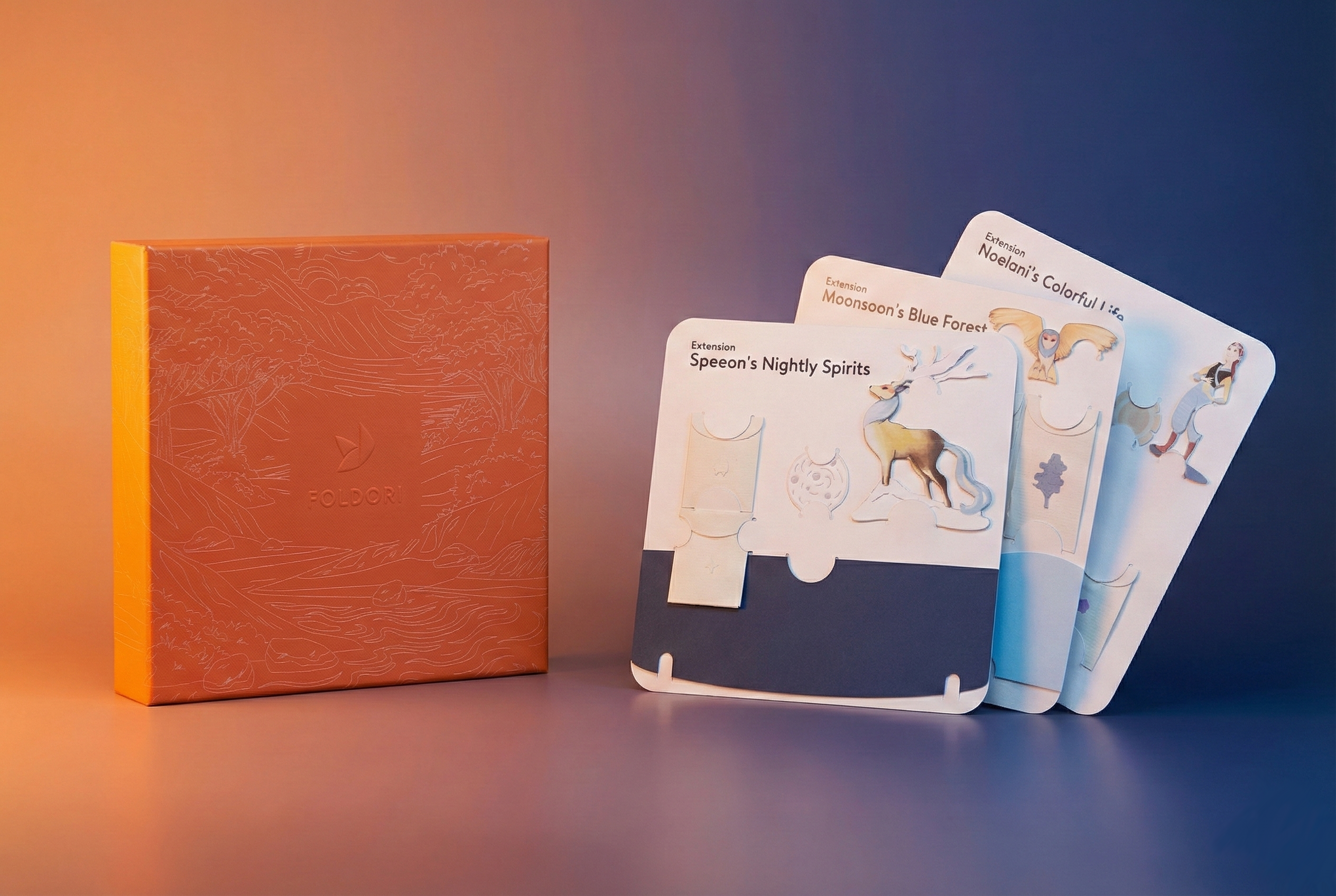
I might be biased, but there is a reason paper is the ultimate medium for focus. Unlike wood or clay, paper is light and unforgivingly precise. Engaging with a FOLDORI set requires what I call micro-focus. When you're aligning a DIY element with a highly detailed shape, the part of your brain that worries about tomorrow’s emails simply has to turn off.
The interesting bit? This isn't just arts & crafts. It's a workout for your spatial reasoning. Working out how a flat sheet becomes a 3D curve draws on the parietal lobe, a brain region involved in spatial reasoning and in maths. By the time you finish the assembly, you’ve actually performed a complex cognitive exercise that leaves you feeling proud, and remarkably clear-headed.
2. Analog correspondence (the lost art of the letter)
There's a profound difference between a ping on a phone and the weight of a fountain pen on heavy stationery. Writing a physical letter to a friend or partner slows down your thoughts. It forces you to compose, rather than react. It’s a slow-motion conversation that rewards both the sender and the receiver.
In the 18th century, the ritual of sealing letters with wax was a mark of personal integrity. Today, that ritual acts as a psychological "full stop". When you press a seal into hot wax, you finalise a thought. It's an incredibly satisfying multi-sensory experience to smell the wax, feel the heat, grasp the resistance of paper: a sense of finality that digital communication lacks.
3. Indoor horticulture and "Forest bathing" at home
Tending to a Bonsai or even a Monstera requires a different type of patience. Plants don't follow a refresh rate. They grow at their own pace. The act of checking soil moisture and pruning leaves connects you to a biological rhythm, which is the natural antidote to the frantic pace of the tech world.
There's a Japanese concept called Shinrin-yoku, or "Forest bathing". While we can't always get to a forest, early studies in mice suggest that a soil bacterium, mycobacterium vaccae, can activate serotonin-producing neurons. Getting a little dirt under your fingernails isn't just for gardeners; it's a simple, tangible way to ground your digital energy into something growing and real.
4. Intentional listening a.k.a. the Vinyl Ritual
In the age of Spotify, music quickly becomes background noise. Reclaim it by making it a primary activity. Put on a record, sit in a comfortable chair, and do nothing else but listen. Removing the visual stimulus of a screen allows your auditory senses to expand, providing a deep sense of immersion.
It's all in the physics of the needle. When you handle a vinyl, you're handling the physical representation of music. The ritual of cleaning the record with a carbon-fiber brush and carefully lowering the tonearm is a high-stakes manual task that requires a steady hand: much like the final assembly of a FOLDORI set, stacking layers with precision. It demands respect for the medium.
5. Mechanical craft
If you're like us, you will likely find the world of mechanical watches fascinating. You don't need to be a watchmaker to appreciate the engineering. Studying how a balance wheel oscillates or how a complication tracks the moon's phase is a lesson in extreme precision and the beauty of friction.
This hobby is a catalyst for the machine's poetry. A mechanical watch doesn't need a battery; it needs you to wind it. It’s a symbiotic relationship between owner and gear. Understanding how so many tiny parts work together to combat gravity is the ultimate inspiration for any paper engineer. It reminds us that whether it's steel or paper, the magic lies in how smoothly the parts interact.
Why "analog" is the ultimate luxury
In 2026, luxury isn't about the newest gadget; it's about the ability to go offline. These hobbies are our little analog sanctuaries. They give a sense of agency, the feeling that you're creating or maintaining something tangible in a world that feels increasingly ethereal.
Whether it’s the silent click of a paper belt or the tick of a mechanical escapement, these sounds are the soundtrack to a calmer mind. They tell your brain: You're here. This is real. You are in control.

Don't try to do all five at once. That’s just another to-do list! Pick one. Set a timer for 30 minutes. Put your phone in another room. Give yourself permission to be 'unproductive' in the eyes of the world, so you can be productive for your own soul. And if you start with FOLDORI, remember: the paper is your partner, not your opponent. Work with the grain, not against it.