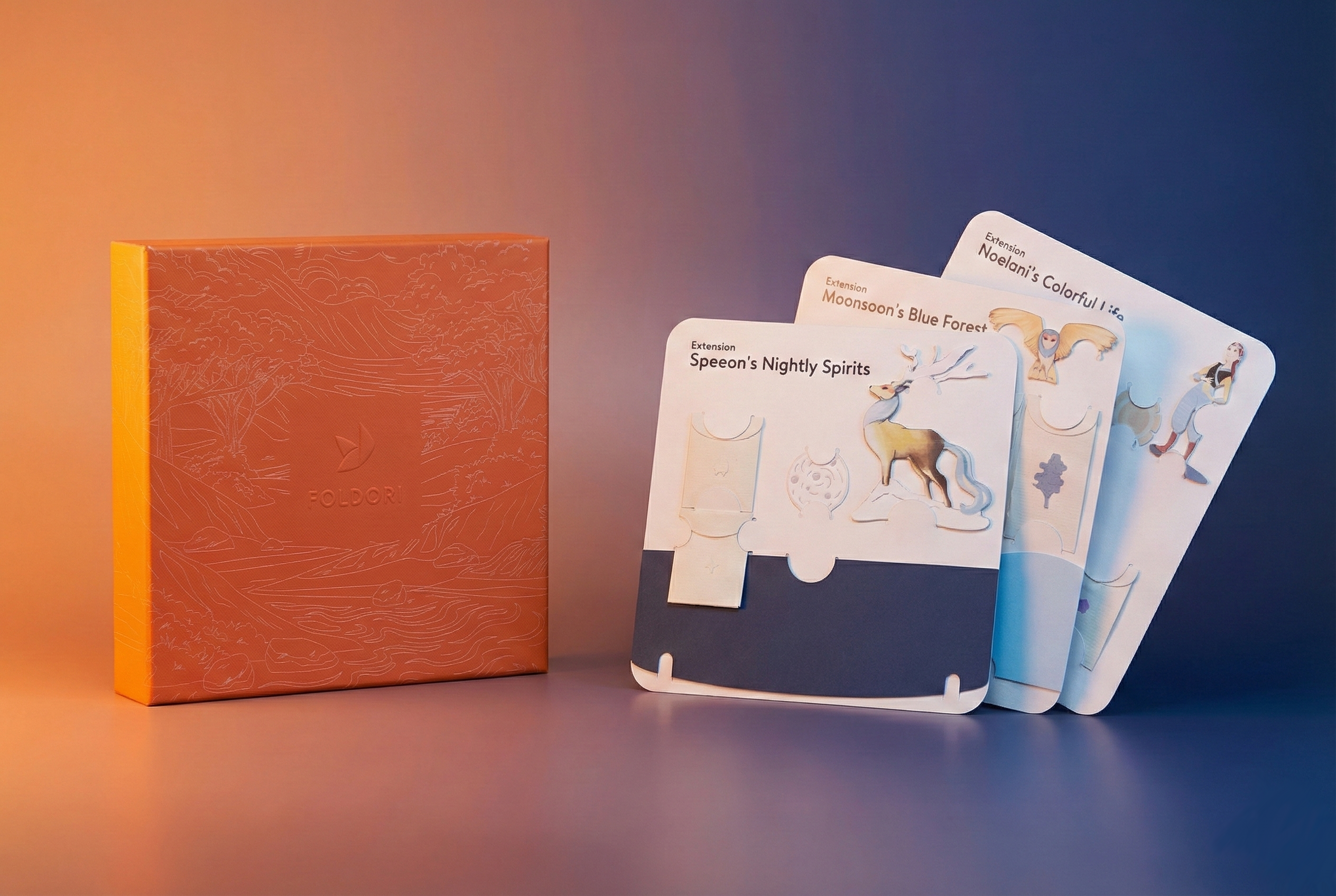

Paper engineering isn't new. Paper cutting has deep roots in Asia, and Europeans cut silhouettes in the 1700s. What changed is precision. FOLDORI ships ten-layer dioramas that lock without glue because we engineered the score angles and the Paper Belt tension with tools the old craftspeople didn't have.
What paper engineering actually means
Paper engineering is the discipline of making three-dimensional structures from flat sheets. The term covers pop-up books, architectural models, packaging prototypes, and what FOLDORI makes: layered story-driven dioramas. The difference between craft and engineering is repeatability. A one-off paper sculpture is craft. A design you can laser-cut fifty times with the same result is engineering. FOLDORI sits at the overlap. We hand-select Fedrigoni Old Mill 250gsm because the long fibers keep the cut edge clean after repeated folds. We engineer the score angles so the fold locks the first time. We design, prototype and manufacture in Europe, with an Italian manufacturing partner, because that's where we can control both the paper and the precision. The result looks handmade; the process is measured in fractions of a millimetre.
The lineage: from paper-cut traditions to laser-cut layers
Paper cutting is one of the oldest paper arts. In Asia, traditions such as Chinese papercutting and Japanese kirigami turned flat sheets into patterns and forms through precise cuts and deliberate folds. European silhouette artists in the 1700s worked a related principle: cut the profile first, then mount it on a backing sheet. The cuts had to be clean or the silhouette bled. In the 1800s, movable and pop-up books layered die-cut sheets. The pages opened to reveal castles, gardens, ships. The engineering was in the hinge placement and the layer spacing. FOLDORI learns from these traditions without claiming them as its own. We cut with the precision the silhouette artists prized, we layer like the pop-up bookmakers, and we add a story of our own. The CO2 laser replaced the craft knife; acid-free European paper carries the print. The geometry is centuries old; the story is new.
Why we chose Fedrigoni Old Mill 250gsm
Fedrigoni is an Italian paper mill founded in 1888. Old Mill is one of their uncoated stocks. Lighter stock folds cleanly but doesn't hold its shape in a ten-layer stack. Heavier stock holds its shape but is harder to cut and fold cleanly. 250gsm is the point where fiber strength meets laser tolerance. The long fibers keep the cut edge clean, and the uncoated surface takes the score without cracking. A Sunrise Dreams diorama ships ten layers of Old Mill cream, thirty-six ivory spacer strips, and a Design Handbook printed on Old Mill 120gsm. You assemble it in under an hour. Paper Belts lock the corners of its paper case. No glue. The fold angle is 38 degrees; that's the angle where the score locks without spring-back. We didn't invent that angle. We found it after four months of prototyping.
The Paper Belt mechanism: tension without adhesive
Pop-up books rely on glued hinges. Modern packaging uses tabs and slots. FOLDORI uses the Paper Belt. A Paper Belt is a 4cm strip of scored paper that you pre-fold, then thread through die-cut slits to lock a corner of the paper case at 90 degrees. Four belts square the four corners. The ten layers then stack inside the case, held apart by the ivory spacer strips on their backs. The design is fixed-tension: once the belt is through its slits, it has the exact pull needed to hold the tabs together. If you skip the pre-fold, the belt fights you. If you follow it, the corner locks and stays locked. The belts ship ready to fold along their score lines. You place them; the geometry does the rest.
From prototype to production: a European supply chain
FOLDORI is designed, prototyped and made in Europe. The company is based in Paris. Our manufacturing partner is Italian. The paper is acid-free Italian Fedrigoni stock; the layers are CO2 laser-cut and offset printed in Europe, and you assemble them at home, without glue. We keep the supply chain short on purpose: it lets us name the mill, talk directly to the production line when a tolerance needs work, and stand behind every layer. A FOLDORI diorama is a European object: paper engineering that respects paper traditions from Asia and Europe, made with European paper and European precision, carrying an original story.
What you're building when you assemble a FOLDORI diorama
A Sunrise Dreams diorama is ten laser-cut paper layers, each representing a different depth in a forest landscape. The ivory spacer strips on the back of each layer create the depth between them. The Paper Belts lock the corners of the case that holds the stack. When you finish, you have an object that sits on a shelf or a desk. The object tells a story. Sunrise Dreams begins at dawn at the edge of the Silvia Forest, where Moonsoon, Noelani and Speeon first meet. You built it, so you know how the depth works. You see the engineering. That's what makes the story land differently than if you bought a finished sculpture. You participated in the structure. The structure is the story.
Paper engineering is a lineage, not a category. FOLDORI learns from centuries of papercutting, the layering discipline of pop-up books, and Italian paper-mill craft. We added laser precision and the Paper Belt mechanism. The result is a ten-layer diorama you can assemble in under an hour without glue. The folds lock because we engineered the score angles. The layers hold because we chose 250gsm Old Mill. The story lands because you built the structure. That's the engineering. That's the heritage. That's FOLDORI.