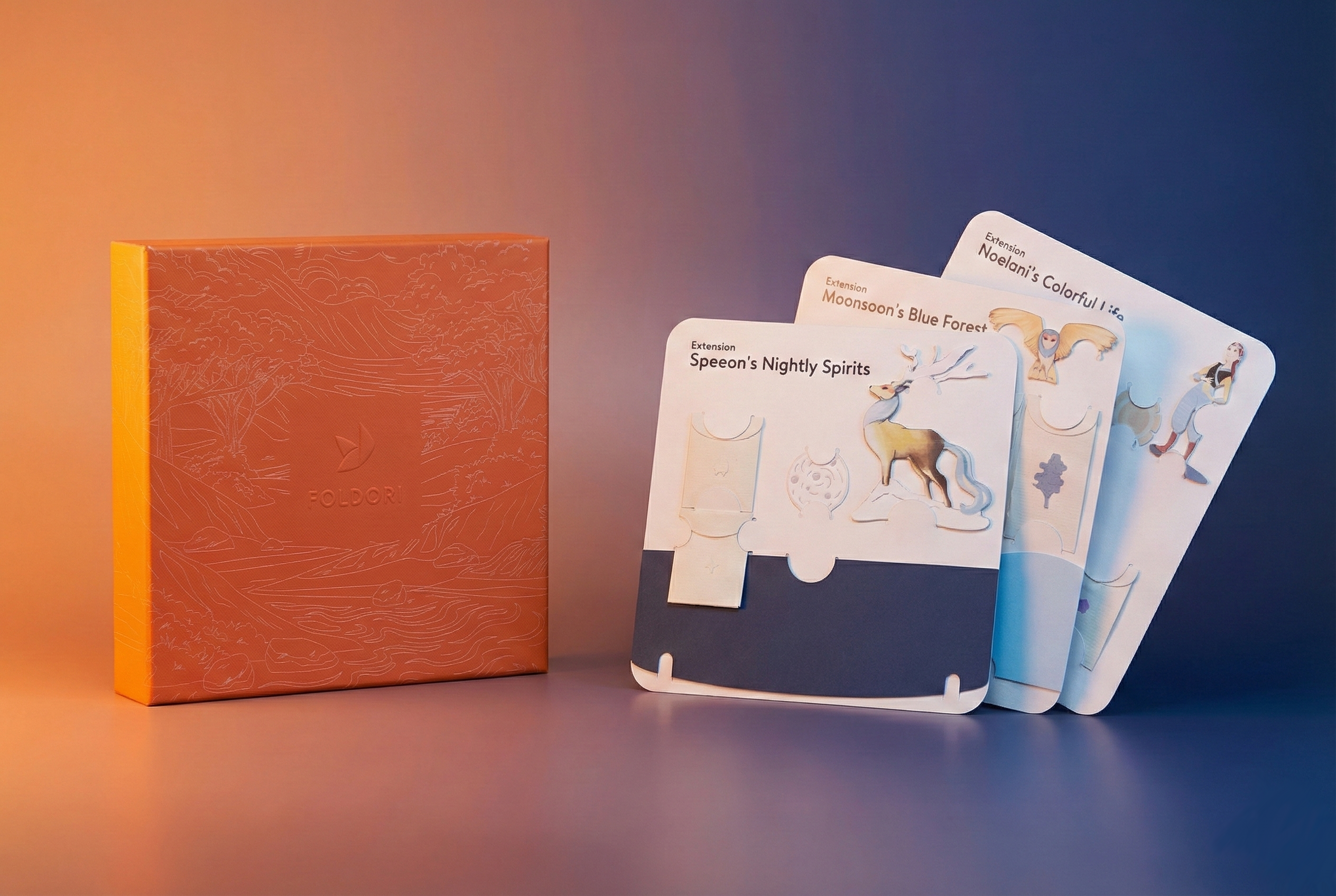

Cutting Paper Art
Papercut art is the centuries-old practice of transforming flat sheets into three-dimensional forms through precision cuts, folds, and layered assembly. At FOLDORI, we engineer this tradition into story-driven dioramas: multi-layer paper sculptures you assemble yourself, no glue required.
How paper art works
The technique relies on two disciplines. First, the cut: laser precision removes material along pre-drawn paths, leaving clean edges that hold tension when folded. Second, the fold: scored lines guide each crease, so the paper bends at exactly the angle needed to lock the structure in place.
Our Sunrise Dreams set demonstrates both. Ten laser-cut layers stack to form a diorama; each layer carries its own cut pattern, and the score lines ensure the folds align across the depth of the scene.
Paper as the honest medium
We chose uncoated Italian paper because the fibers stay clean at the cut edge. A coated stock chips; an uncoated stock from a long-fiber mill holds the geometry. The material does half the engineering work before you touch it.
Cutting paper art at this scale demands acid-free stock. The diorama you assemble today should not yellow in five years. We source from Fedrigoni Old Mill: the same paper European conservators specify for archival work.
The assembly experience
You receive the layers pre-cut and pre-scored. Your task is to peel each element from its backing sheet, fold along the scored lines, and stack the layers using the Paper Belt mechanism. The cutting is already done; the art emerges as you assemble.
Most customers complete a Classic Set in under an hour. The process is contemplative, not rushed. You place one layer, check the alignment, secure it, then move to the next. By the final layer, you have built something display-worthy.
Visit How to DIY to explore the expertise behind FOLDORI art sets: Paper DIY, from craft engineering to multi-layered paper dioramas.