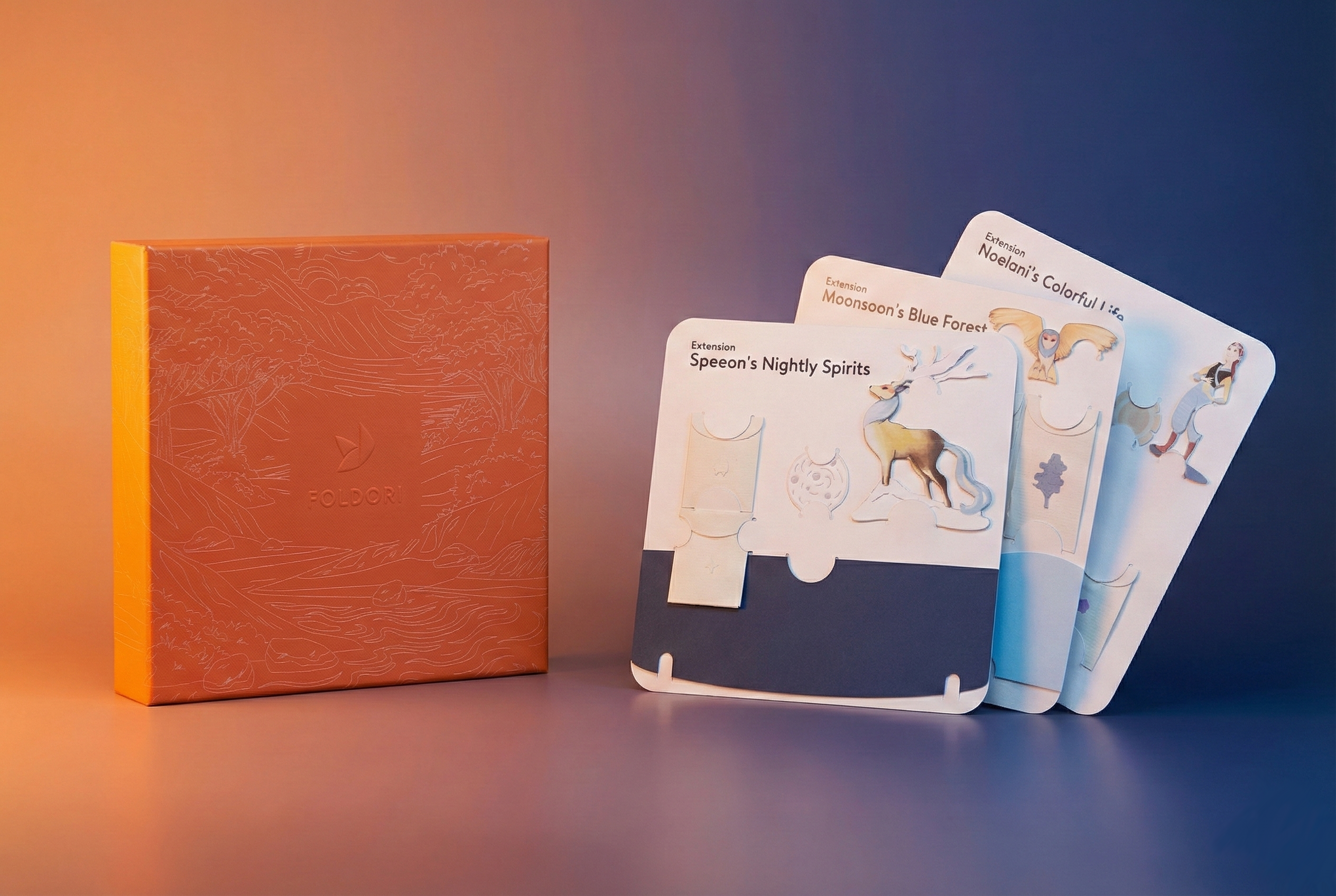

Paper engineering transforms flat sheets into three-dimensional structures that spring to life when you open them. It's the technical discipline behind pop-up books, architectural models, and those greeting cards that make people gasp. At FOLDORI, we use these same principles to create pieces that aren't just looked at but experienced.
The mechanics of dimensional paper
Paper engineering is the practice of designing and constructing movable paper structures through precise cutting, scoring, and folding techniques. Unlike origami, which relies solely on folds, paper engineering combines multiple methods to create mechanical movement. The discipline draws from architecture, graphic design, and structural engineering. Every crease serves a purpose. Every cut creates potential for motion. A well-engineered piece considers paper grain direction, weight distribution, and the physics of how materials behave when manipulated. The Kirigami technique, for instance, uses strategic cuts to allow paper to expand and contract in ways that pure folding cannot achieve. Engineers calculate angles, test prototypes, and refine mechanisms until a single pull-tab or page-turn triggers the exact movement intended.
Historical foundations of the craft
The roots of paper engineering trace back to 13th-century movable astronomical charts called volvelles. By the Victorian era, publishers were creating elaborate pop-up books for children, though the term 'pop-up' wouldn't emerge until the 1930s. European toy theatres in the 1800s used similar principles, with layered paper scenes that created depth and dimension. The craft evolved through greeting card innovation in the mid-20th century, when commercial designers refined techniques for mass production. Modern paper engineers stand on centuries of experimentation, but the fundamentals remain unchanged: understanding how a two-dimensional material can be manipulated to occupy and move through three-dimensional space. Today's practitioners blend this heritage with contemporary tools, using laser cutting for precision while maintaining hand-assembly for pieces that demand the human touch.
Core techniques every engineer uses
Several fundamental mechanisms form the vocabulary of paper engineering. The V-fold creates the basic pop-up action, where two surfaces meet at an angle and pull a central element upward as pages open. Parallel folds allow structures to rise in layers, building height and complexity. The floating layer technique suspends elements in space, attached only at specific anchor points. Box folds create cubic forms that collapse flat and expand into defined volumes. Each mechanism can be combined, layered, or modified. Scoring (creating a controlled weak point for clean folds) is as critical as cutting. Paper choice matters enormously: too thin and structures collapse, too thick and they resist movement. Engineers must consider whether a piece will be opened repeatedly or just once, whether it needs to ship flat, and how it will age. The Sunrise Dreams Classic Set applies these principles: ten laser-cut layers that keep their spacing inside a paper case whose corners are locked by Paper Belts.
Engineering versus artistic decoration
There's a crucial distinction between paper engineering and surface design. Engineering concerns itself with structure, movement, and mechanical function. A piece can be beautifully engineered using plain white paper, because the innovation lives in how it moves, not how it looks. Decoration, while valuable, is a separate consideration. This is why, at FOLDORI, the illustration printed on each layer serves the structure: the depth comes from the spacing between the layers. The paper itself is the medium and the message. When you strip away decorative distraction, the engineering becomes visible. You see the intelligence in each fold, the intention behind every cut. This approach respects both maker and recipient. It says: the craft is enough. The structure is the beauty.
Tools of the paper engineering studio
Professional paper engineers work with deceptively simple tools. A sharp craft knife with replaceable blades is essential for clean cuts. Metal rulers provide straight edges that won't get damaged by repeated blade runs. Bone folders create crisp creases without tearing fibres. Cutting mats protect work surfaces and self-heal after thousands of cuts. Precision matters: a misalignment of even one millimetre can prevent a mechanism from functioning properly. Many engineers use digital tools for design (CAD software helps calculate angles and test movements virtually), then prototype by hand. Laser cutters allow for intricate detail and perfect repeatability, which is why every FOLDORI layer is CO2 laser-cut. But assembly remains a human task. Machines can cut, but they cannot feel when paper is stressed beyond its tolerance or notice when a fold isn't quite crisp enough.
How paper engineering shapes our collections
Every FOLDORI piece begins with structural questions, not aesthetic ones. How will this move? What will someone feel when they interact with it? Can it survive being shipped, opened, displayed, and potentially moved again? The Sunrise Dreams Classic Set took four months of prototyping. Each of its ten layers had to sit at the right distance from the next, so the forest reads with depth while the stack stays stable. This is engineering in service of emotion: you see a forest at dawn and feel awe, but that feeling only works because the structure is sound. Miraki often reminds the studio that decoration can be added later, but structural integrity must be designed from the beginning. A poorly engineered piece fails no matter how beautiful its surface. A well-engineered piece succeeds even before any colour is applied.
Learning the discipline yourself
Paper engineering is learnable, but it requires patience and systematic study. Start with simple mechanisms: create a basic V-fold card before attempting complex layered scenes. Study existing pop-up books and greeting cards by carefully examining how they're constructed. Take them apart if necessary (charity shops are excellent sources for inexpensive study materials). Work with affordable paper first. Printer paper and thin card stock allow you to prototype without fear of wasting premium materials. Keep a mechanism journal: when you discover how something works, sketch it and note the principles involved. Understanding why a technique functions is more valuable than memorizing its execution. Resources exist online, but nothing replaces hands-on experimentation. The paper will teach you through failure: when a fold tears, you learn about grain direction; when a pop-up won't stay up, you learn about tension and balance. Nicola has been developing tutorial content for those wanting to explore these techniques, because the craft deserves new practitioners who understand its foundations.
Where paper engineering is heading
The discipline continues to evolve as new tools and materials emerge. Laser cutting has democratized precision that once required industrial equipment. Digital design software allows engineers to simulate movement before cutting a single sheet. Yet the fundamentals remain rooted in physical understanding: paper is still paper, and gravity is still gravity. Contemporary engineers are exploring larger architectural installations, kinetic sculptures that respond to air movement, and pieces that integrate lighting or other materials. But there's also a counter-movement toward restraint and refinement rather than spectacle. At FOLDORI, we're more interested in perfecting classic mechanisms than chasing novelty for its own sake. The challenge is making traditional techniques feel fresh by applying them to unexpected contexts. A well-engineered structure from 1850 still works today because the physics haven't changed. Our goal is creating pieces that will still function and still resonate decades from now, which requires focusing on timeless structural principles rather than temporary trends.
Paper engineering is where technical precision meets spatial imagination. It's a craft that rewards those who think systematically about how materials behave, who test relentlessly, and who understand that constraints drive creativity. At FOLDORI, these principles guide everything we make: pieces that work beautifully because they're engineered properly, and that endure because they respect both material and method. The next time you open a pop-up card or unfold a dimensional paper piece, look past the surface and see the engineering underneath. That's where the real craft lives.
Want to try paper engineering yourself? Our Sunrise Dreams paper diorama kit is laser-cut from Italian paper and assembles without glue in under an hour (pre-order, estimated shipping April 2027). Get the Classic Set and all three story extensions in the Full Suite for €112 and save €20.